How to price your B2B product before your first 100 customers
October 22, 2026 · Uncategorized
Estimated reading time: 7 minutes
My first price was copied. I looked at what similar tools charged, picked a number close to theirs, and moved on.
Later I ran a free pilot with a hospital. The pilot went well. Then I had to ask them to pay, and I had no real reason behind my number. When they pushed back, I dropped the price almost at once. Too fast.
That one moment taught me more about pricing than any book. This post is what I wish I had known before it happened. It is for B2B founders somewhere between zero and 100 customers who have no pricing team, only a doc and a nervous feeling.
The short version: price on the value your buyer gets. Ask 10 to 20 buyers before you set a number. Offer two or three clear plans. Charge on something that grows as the customer gets more value. And never give a discount without getting something back.
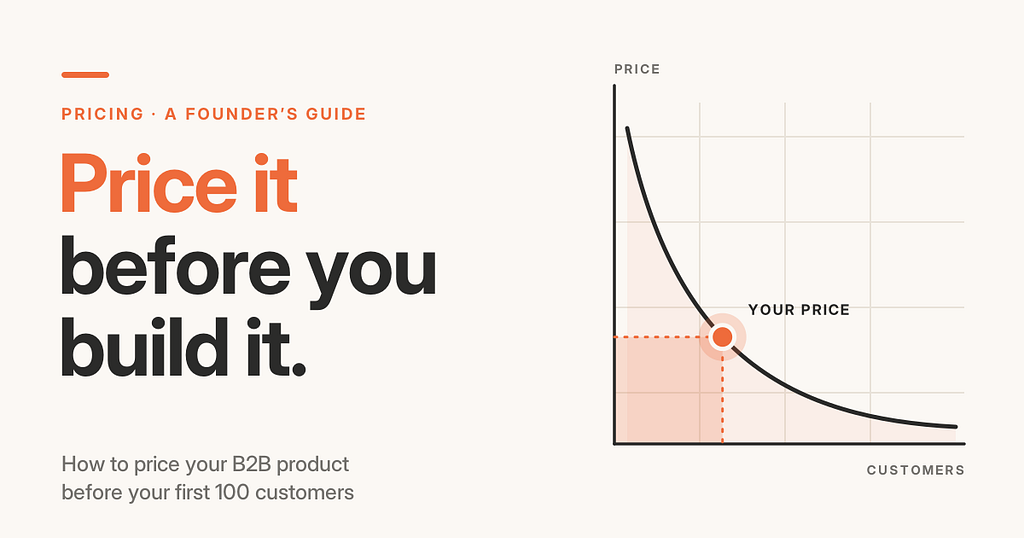
Here is how to do each of those.
Why should you think about pricing before you build?
Because your price tells you how valuable your product must be to the buyer. If you wait until launch to set it, you may learn that nobody values what you built enough to pay for it. Pricing is a product decision, not a finance task.
Most founders do it the other way round. I did. I built first and copied a price later, so my price had nothing to do with what buyers actually valued.
The fix is simple. Before you build the next feature, find out if anyone would pay for it.
Do this today: write down your top five planned features. Next to each one, write the name of a real buyer who has said they would pay for it. If a feature has no name next to it, it is a guess.
How do you find out what customers will actually pay?
Ask them. Talk to 10 to 20 buyers per segment before you set a number. Ask what the problem costs them today, what they already spend on it, and at what price your product would feel cheap, fair, expensive, and too expensive.
This is called a willingness-to-pay conversation. Pricing expert Madhavan Ramanujam explains why founders should have these early and often in this podcast episode.
In clinics and hospitals, I found the buyer often compares you with the cost of one more person on staff, not with another software tool. Ask what they spend on people to solve the problem today. That is your real competitor.
Do this today: use this script on your next five calls.
- How do you handle this problem today?
- What does that cost you each month, in money, staff time, or lost customers?
- If this worked perfectly, what would that be worth to you?
- At what price would this feel so cheap that you would doubt it? Fair? Expensive, but you would still consider it? Too expensive?
Who exactly are you pricing for?
Group your buyers by what they value, not only by company size. Two customers of the same size can want different things and pay different amounts. Give each group its own plan, its own message, and its own sales approach.
Take a one-doctor clinic and a large hospital. The clinic owner wants something simple, quick to start, and cheap to try. The hospital has many people involved, needs approvals, and wants proof before it commits. Same product. Very different buying.
Do this today: list your last 20 prospects. Next to each, write the main reason they cared about your product. Group the reasons. You will usually find two or three segments.
How should you package your product into plans?
Offer two or three plans with clear differences between them. Buyers need something to compare. Put the features buyers want most in every plan, and separate the plans by how much the customer uses or how much support they get.
One caution. Sometimes a buyer wants only one thing. Then one simple plan is better than three. Do not force tiers on someone who knows exactly what they need.
Do this today: put every feature you have on a sticky note. Sort them into three piles, using the terms from Kevin Cohn’s article on bundles: leaders are the features that make a buyer want the plan at all, fillers are nice extras, and killers are features that put buyers off. Build your middle plan around the leaders.
How should you handle discounts and price changes?
Never cut the price on its own. If a buyer asks for a discount, change the scope, the contract length, or the payment timing instead. Raise prices when almost nobody pushes back. And tell existing customers before you change anything.
My biggest pricing mistake was a fast discount. The buyer pushed back once, and I dropped the price almost at once. I did not ask what made it feel expensive. I did not offer a smaller scope. The buyer learned that my first number was not my real number.
If you give something, get something. Here are three fair trades:
- A smaller scope for a lower price
- A longer contract for a lower price
- Payment upfront for a lower price
When should you raise your price? A simple signal: if almost every prospect says yes without any questions, you are probably too cheap. Review your price after every 10 to 20 new customers.
When you do raise it for existing customers, give notice, keep their old price for a set period, and add something of value at the same time.
Do this today: look at your last 10 deals. For each one, write who asked for a discount, what you gave, and what you got back. If the last column is empty, you have your answer.
What pricing mistakes hurt early B2B startups most?
Four come up again and again: copying competitor prices, giving free work with no end date, quoting a custom price for every deal, and discounting without a trade. I have made two of them myself.
- Copying competitors. You inherit their guess. Their costs, their buyers, and their goals are not yours. Fix: set your price from buyer calls, then check competitors as a sanity test only.
- Free work with no end date. A pilot or demo with no agreed next step drifts. Fix: before it starts, agree the result you will measure, the end date, and what the next step costs.
- A custom price for every deal. Every proposal starts from zero, and every buyer wonders if they got the best deal. Fix: two or three standard plans, with one clear way to add extras.
- Discounting without a trade. You teach buyers to ask for more. Fix: always trade scope, term, or payment timing.
Your one-week pricing sprint
You do not need a pricing team. You need one focused week.
- Day 1: list your features and name the buyer who wants each one.
- Days 2 and 3: run five willingness-to-pay calls with the script above.
- Day 4: group your last 20 prospects into two or three segments.
- Day 5: draft two or three plans and decide what you charge on, such as per location or per doctor.
- Day 6: show the plans to three buyers and ask if the price feels fair.
- Day 7: write your pilot rules and your discount rules. One page each.
Pricing is not a number you find once. It is a question you keep asking. My first price was a copy, and my first discount was a flinch. Both were fixable. Yours will be too.
PS: What price did you copy from someone else, and did it work out?
- Day 1: list your features and name the buyer who wants each one.
- Days 2 and 3: run five willingness-to-pay calls with the script above.
- Day 4: group your last 20 prospects into two or three segments.
- Day 5: draft two or three plans and pick your value metric.
- Day 6: show the plans to three buyers and ask if the price feels fair.
- Day 7: write your pilot rules and your discount rules. One page each.
Pricing is not a number you find once. It is a question you keep asking. My first price was a copy, and my first discount was a flinch. Both were fixable. Yours will be too.
PS: What price did you copy from someone else, and did it work out?
Originally published on Medium.